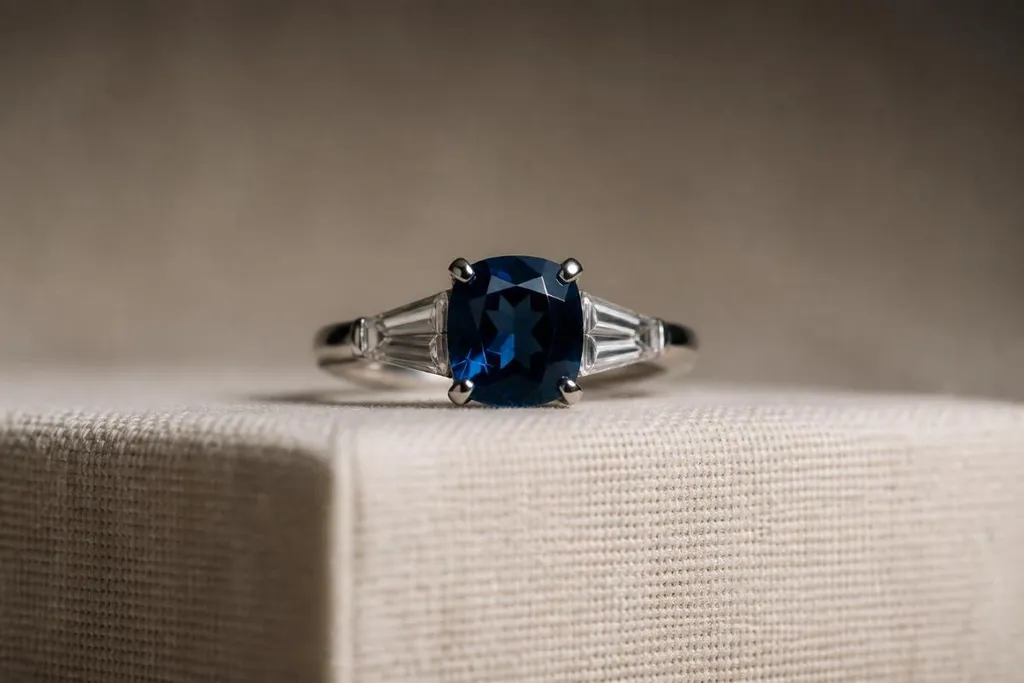
Few engagement ring designs are as immediately recognisable as a deep blue sapphire surrounded by a bright halo of diamonds. The combination carries obvious royal associations, but its longevity comes from more than history. Strong colour contrast, balanced proportions and a traditional cluster arrangement give the style enough visual presence to feel special while retaining the symmetry expected of classic fine jewellery.
For those drawn to this aesthetic, the option to order the Diana ring from Lily Arkwright offers a contemporary interpretation built around a lab-grown blue sapphire and lab-grown diamond detailing. Rather than treating the sapphire as an alternative version of a diamond centre stone, the design celebrates colour as its defining feature. Understanding how the centre stone, surrounding halo and precious metal interact helps explain why this style has remained so enduring.
Why the Sapphire and Diamond Combination Works
The appeal begins with contrast. A richly coloured blue sapphire creates a strong central focal point, while the surrounding lab-grown diamonds introduce brightness around its edge.
This arrangement does two things visually. First, the lighter halo defines the outline of the darker centre stone, making the sapphire's colour appear particularly prominent. Second, the surrounding stones increase the overall face-up presence of the ring without requiring the centre gemstone itself to account for all of that scale.
That distinction matters when choosing an engagement ring. Someone might prefer a substantial solitaire because they want one uninterrupted gemstone to dominate the design. A Diana-inspired cluster appeals for a different reason: it creates presence through composition. The eye sees colour, contrast and sparkle working together.
Blue also has unusual versatility for a strongly coloured gemstone. It can feel dramatic against pale clothing yet sophisticated beside navy, black and other classic wardrobe colours.
The Importance of the Oval Centre Stone
The oval shape is fundamental to the Diana-style silhouette.
Its elongated proportions provide more vertical movement than a round centre stone while retaining curved edges and a traditionally elegant appearance. Once surrounded by a halo, that length becomes even more noticeable, creating a ring that covers the finger gracefully without relying on an angular outline.
Proportion is particularly important in this type of design. If the centre stone is too narrow relative to its length, the overall cluster can appear stretched. A broader oval produces a fuller silhouette, although personal preference should ultimately determine which proportion feels most attractive.
The surrounding diamonds should also support rather than overwhelm the sapphire. Their purpose is to frame the blue centre and provide contrast. If the halo becomes disproportionately large, the visual emphasis can shift away from the gemstone that gives the ring its distinctive identity.
This careful balance is one reason successful cluster designs feel refined despite containing considerable detail.
How Precious Metal Changes the Character
The metal surrounding a blue sapphire can influence the overall mood of the ring.
White gold or platinum creates a cool, cohesive background for the lab-grown diamond halo. The pale metal visually blends with the surrounding stones, allowing the blue centre to stand apart clearly.
Yellow gold produces a more pronounced contrast. Its warmth against blue can give the design a richer, more traditional character while making the metal itself an intentional part of the composition.
The best choice should also consider jewellery already worn regularly. Matching an engagement ring to a preferred metal can make pairing it with a wedding band and other pieces easier over the long term.
Setting construction deserves practical attention as well. A detailed halo contains numerous individual stones and settings, so periodic inspection is sensible for a ring intended for daily wear.
Styling a Royal-Inspired Ring for Modern Wear
Despite its historical associations, a sapphire cluster does not need to be styled formally.
Its strong centre colour means the ring can provide the principal jewellery statement, allowing other pieces to remain restrained. Simple earrings, a fine bracelet or an understated wedding band can prevent the overall look from becoming overly decorative.
Wedding-band pairing requires particular thought because the cluster setting may influence how closely a straight band can sit alongside it. Considering the engagement ring's profile before selecting a wedding band can produce a more comfortable, intentional combination.
Regular gentle cleaning also helps maintain the contrast between the blue centre and bright surrounding stones, which is central to the design's appeal.
Final Thought
The Diana-inspired sapphire ring has endured because its beauty does not depend solely on royal association. Its strength lies in proportion: a distinctive oval blue centre, a bright surrounding halo and precious metal that frames both elements cohesively.
For someone who wants an engagement ring with colour, heritage and unmistakable presence, the style offers something a conventional solitaire cannot. Its history may make it recognisable, but thoughtful balance is what keeps the design relevant.